1. It was licensed, not built, in 1383
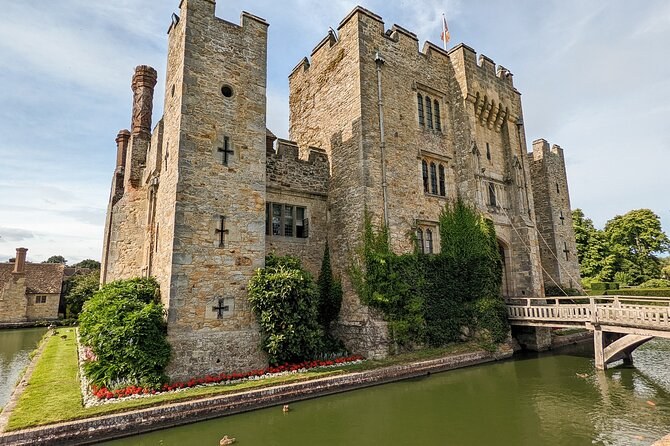
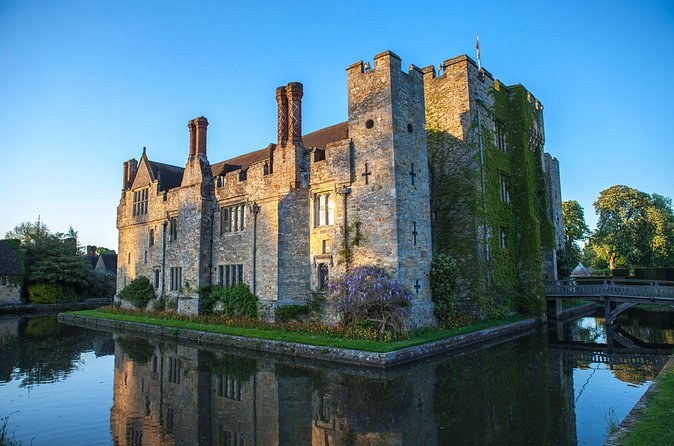
John de Cobham was granted a licence to crenellate an existing house at Hever in 1383. A castle in England was a permission before it was a building, and the moat, walls, towers and gatehouse all date from what he did with it.
2. There was something here seventy-five years earlier
A building called Hever Cobham was inherited by Stephen de Cobham, Baron Rundale, in 1308. It was a motte-and-bailey castle around a timber great hall with a central hearth. Nothing of it survives above ground; the evidence is entirely documentary.
3. The walls were white
The fourteenth-century exterior was whitewashed with powdered chalk and water, which weatherproofed it and made it far more dramatic than the grey stone you see now. The front was painted in strong colours.
4. Anne Boleyn grew up here, and was not born here
Anne Boleyn was born elsewhere and raised at Hever, and the distinction is the estate's own. It matters because so much writing about the castle gets it wrong. She grew up here with her sister Mary and her brother George, and came back in about 1526–28 to get away from the court. The room shown as the Nursery is where the children most likely slept.
5. The Anne's-bedroom story is a myth, and the castle says so
A tradition going back to the seventeenth century calls the Nursery Anne's own bedroom. Hever's own text names it as a myth. It is one of the more honest labels in any English country house.
6. Anne of Cleves owned it, and built more of it than anyone realises
Henry VIII's fourth wife held Hever from 1557. Three of her additions still stand: the Entrance Hall on the front of the house, the grand staircase and Staircase Gallery, and the Long Gallery running the castle's full width. The history page has the sequence.
7. The Long Gallery's windows were bricked up to dodge a tax
The window tax arrived in 1696 and the north wall's windows were bricked up to avoid the window tax introduced in 1696, and reopened in 1898. Two centuries of a gallery with one side blind, because of a levy on daylight.
8. A chimney brought down a corner of the castle
In the nineteenth century the north-east corner collapsed under the weight of a fifteenth-century chimney that had been built on top of the kitchen flue. The kitchen was moved into the Great Hall in 1838 as a result, and the fireplace only reached its present position in 1898.
9. The richest man in America bought it
William Waldorf Astor inherited a fortune in 1890 that made him the richest man in America, announced that the country was “no longer a fit place for a gentleman to live”, moved to England in 1891 with a reputed hundred million dollars, and bought Hever on 27 July 1903.
10. 748 men on the castle, 800 more on the lake
The restoration ran from 1903 to 1908. 748 men worked on the building and a further 800 dug the 38-acre lake by hand. Every fragment of the original structure was kept, and the workmen were allowed the adze and the chisel but not the modern plane.
What an American fortune bought at Hever between 1903 and 1908
| What Astor built | When | Still there |
|---|---|---|
| The Tudor Village, now the Astor Wing | 1903–06 | Yes — it is the timber-framed range behind the castle |
| The Italian Garden and Pompeian Wall | 1904–08 | Yes, with his Greek and Roman statuary in it |
| The 38-acre lake | 1904–08 | Yes, and you can row on it |
| The Yew Maze | Edwardian | Yes — one of few traditionally designed mazes left in the country |
| The reinstated drawbridge | 1903–06 | Yes, and it still lifts |
11. Two of the three portcullises are still there
The Gatehouse originally housed three. The central one was removed in the 1830s by Jane Waldo, and the other two survive. The front portcullis in the Courtyard is said to be one of the oldest working portcullises in the country.
12. There is a fourteenth-century lavatory over the moat
The Gatehouse still contains its garderobe, which emptied directly into the water. It is the most medieval thing in the building, and the route ends there.
13. It is not National Trust and it is not English Heritage
Hever Castle is privately owned. It is not a National Trust property and it is not English Heritage. It has been in private hands since 1383 and was sold to its present owner in 1983, twenty years after Gavin Astor first opened it to the public. Memberships of those organisations buy you nothing at the gate.
What you can still see of each of these
Facts about a building are worth more when you can put your hand near them, and most of this list is still standing. Here is where you will find it.
- The 1383 work — the gatehouse, the moat, the walls and the towers. You walk through all of it twice.
- The garderobe — in the Gatehouse, at the end of the route, and easy to walk past if you are already thinking about the tea room.
- The bricked-up windows — the Long Gallery's north wall. They were reopened in 1898, so what you are looking for is the joint rather than the brick.
- Astor's lake — you can take a boat out on it, which is a strange thing to do to a fact.
- The two portcullises — one in the Gatehouse and one in the Courtyard, the second said to be among the oldest working portcullises anywhere in England.
What you cannot see is the whitewash, the motte-and-bailey castle of 1308, or the corner that fell down. For those you have the castle page, which sets out what each room was before it was what it is.
Why so much of this is Edwardian
If you take one thing from the list, take this: the shape of Hever is medieval and almost every surface you will admire inside it is a hundred and twenty years old. That is not a criticism. Astor's team rebuilt with sixteenth-century materials and sixteenth- century tools, kept every original fragment, and produced work good enough that visitors routinely mistake it for Tudor.
Knowing which is which makes the visit better rather than worse, and it is the difference between admiring a room and understanding it. The gardens page is the same story outdoors: 125 acres that were marshland when your great-grandparents were young.
Where the facts come from
Every one of these is published by Hever Castle itself, on its history pages and its castle timeline. That is deliberate. Dates about a private house are exactly the kind of claim that is easy to write from memory and often wrong, and the estate is the only authority on its own building.
If you want to check them yourself, you will need Castle & Gardens rather than Gardens Only, and you will want more than the hour the estate suggests. The visiting page has the 2026 prices and the hours, and day tours to Hever Castle give you long enough on site to find most of this list against the rooms.
Want the stories told properly on the way out? Hever Castle Tours compares the days where somebody drives and the days where somebody explains.